
India’s rapid delivery boom is creating a new shortcut for Korean food (K-food) companies to enter one of the world’s fastest-growing consumer markets.
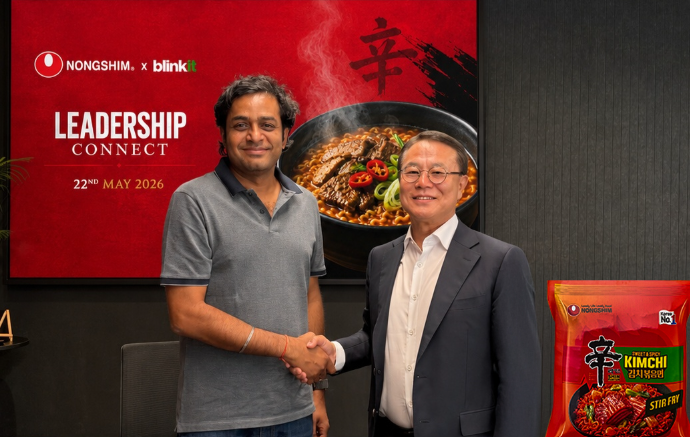
Instant noodle maker Nongshim will begin selling 19 of its products—including Shin Ramyun and kimchi-flavored Shin Ramyun—via quick-commerce delivery in major Indian cities such as New Delhi and Mumbai. The rollout will happen through Blinkit, India’s largest quick-commerce platform, according to the company.
Lotte Wellfood has already been selling ice cream products such as World Cone through quick-commerce platforms in India, including Blinkit and Zepto. The company reportedly generated more than 10 billion won ($6.7 million) in sales through quick-commerce channels alone last year.
India’s broader e-commerce market is projected to grow from $90 billion in 2025 to $240 billion by 2030, according to the Korea International Trade Association.
Within that, the quick-commerce segment is expected to expand even faster, increasing more than sixfold from $8 billion to $50 billion over the same period.
“Entering India’s quick-commerce market has become essential for Korean food companies,” said a K-food industry source.
India is increasingly seen as a key future export destination for K-food companies, given its population of 1.4 billion, status as the world’s fifth-largest economy, and a median age of 28.8 years.
As global food companies intensify competition in India, demand for Korean food is also rising, particularly among younger consumers.
“K-food has become significantly more popular and mainstream in India over the past couple of years,” said Pallavi Dobhal, a 25-year-old Indian employee working at Nongshim’s headquarters in Seoul. “Even local Indian food companies are launching products inspired by Korean flavors, making K-food one of the biggest trends in India’s food market.”
Nongshim’s exports to India grew at an average annual rate of 18.3% from 2023 to 2025, while Lotte Wellfood’s sales in the country rose 12.3% year-on-year to 326.2 billion won last year.
Korean food companies are also strengthening localization strategies tailored to India’s culture, climate, and dietary preferences.
Nongshim is currently selling a variant of Shin Ramyun made with chicken broth, one of the most popular meats in India. The product also includes curry spices adapted to local tastes and is halal-certified.
Lotte Wellfood manufactures products including Choco Pie, Pepero, and World Cone at six factories in India. The company has also developed a chocolate formula designed to withstand India’s hot and humid climate.
It has also introduced a vegetarian version of Choco Pie by replacing animal-based gelatin with plant-based ingredients.
Lotte Wellfood’s crispy, cookie-coated ice cream bar, the Dweji Bar (meaning “Pig Bar” in Korean), is marketed in India as “Krunch” to avoid references to pork that could conflict with local religious and cultural sensitivities.
Food conglomerate Orion also manufactures and sells its Choco Pie products in India through local production.
“Food culture varies significantly across India, with wheat-based diets common in the north and rice-based diets more prevalent in the south and east,” said Kim Chan-wahn, a professor at Hankuk University of Foreign Studies. “K-food will gain more popularity if companies take these regional differences into account.”